Safety Tips!!
Recommended Pet First Aid Training
Learning pet first aid and emergency response skills before an emergency happens can make a major difference.
Suggested training resources:
- American Red Cross Pet First Aid Classes
https://www.redcross.org/take-a-class/first-aid/cat-dog-first-aid - Other wilderness first aid and hiking safety classes that might address:
- Wound care
- Heatstroke recognition
- Bleeding control
- Snakebite response/Rattlesnake Aversion Training (harm/fear free for both dog and snake, preferably) *There is a rattlesnake vaccine for dogs you may wish to research…
- Paw injury care
- Emergency evacuation planning
Start Slow & Build Endurance
- Train your dog with shorter hikes before attempting long or high-altitude hikes.
- Gradually increase mileage, elevation, terrain difficulty, and duration.
- Puppies, seniors, brachycephalic breeds, and dogs with health conditions may require extra precautions.
- Really check the details of any trail before you go, noting elevation, difficulty, miles and any cautions the parks put with the different trails. Many hikers assume “I can hike 5 miles before it’s dark” without noting important things about the trails that make it more difficult and get stuck under prepared.
- Never hesitate to change your plans if you or your pet are tired. Exhaustion leads to injury.
Know Your Dog’s Limits
Watch for signs of:
- Overheating
- Altitude sickness
- Exhaustion
- Paw injuries
- Dehydration
- Stress or anxiety
Signs your dog may need a break:
- Excessive panting
- Refusing to walk
- Lagging behind
Seek immediate veterinary attention if you dog is/has:
- Stumbling or weak
- Pale gums (dehydration)
- Red gums (severe overheating - hyperthermia)
- Pour water on paws, armpits and groin areas if dehydration or overheating is suspected as you seek help.
- Blue gums (hypothermia)
- Vomiting or diarrhea
Research Before You Go
- Confirm dogs are allowed on the trail.
- Review wildlife risks.
- Know local weather patterns, including check the tide schedule.
- Identify nearby emergency vets.
- Identify which vets carry rattlesnake antivenom if hiking in snake country.
- Download offline maps before entering areas with poor service. A paper printout of a map is always a great back-up plan.
- Know state hunting seasons and be aware of hunters present or nearby during hunting season. Wear bright colors on the trail especially during these seasons!
Bring More Water Than You Think, especially at higher altitudes!
Recommended Hydration Gear
- Collapsible water bowl
- Dedicated dog water bottle or flask
- Extra water reserves
- Hydration bladder for humans
- Cooling towels and/or cooling vests in hot weather
- Consider carrying a mini water filtration system
- Bring electrolytes for humans!
- Also be certain to pack snacks for both humans and the pups!
Water Safety Tips
- Offer water frequently.
- Do not wait until your dog appears thirsty.
- Avoid stagnant or contaminated water sources.
*Be sure to practice with this gear, so that in the event you need to use a sling or booties, etc., your dog is familiar with the item and accepting. De-sensitizing them to these items in advance might prove clutch in an emergency.
Harness
Recommended features:
- Secure fit
- Lift handle
- Durable attachment points
- Visibility features
*If your dog can get out of their collar or harness, consider a prong collar safety clip.
Booties / Paw Protection / Paw Balm
Useful for:
- Sharp rocks
- Hot ground
- Snow and ice
- Long mileage
- Rough terrain
- Hot pavement safety
- Be aware of how different the air temp is vs feel temp vs pavement/concrete/asphalt/sand/blacktop!
**Generally, dogs should not wear boots for more than 4-6 hours at a time without regular breaks for inspection and potential removal. It's important to monitor your dog's behavior and physical condition closely when wearing boots, and to remove them periodically to check for skin irritation and moisture accumulation.
Also consider dog goggles for pup eye safety, especially if hiking in the desert.
Emergency Rescue Sling / Carry Harness - One of the most repeated recommendations!
Purpose:
- Carry an injured or exhausted dog out of the trail.
- Especially important for long-distance or remote hikes.
- Always important for elderly dogs.
Dog Backpack / Day Pack
Can allow very fit dogs to carry:
- Their own water
- Snacks
- Waste bags
- Small gear
Only use if:
- Dog is physically conditioned
- Pack weight is appropriate
- Weight is evenly distributed
Collar & Identification
Always carry:
- Updated ID tags
- Microchip information
- Extra leash
- Backup lead/slip lead
Community-Recommended First Aid Kit Contents that members should customize to their kits for their dog’s/their specific needs:
- Multi-tool (can cut down on some of the items below, and maybe even one with a flashlight on it)
- A headlamp and also backup lighting
- Mesh muzzle
- Tweezers
- Medical scissors
- Tourniquet
- Blood stop powder (styptic powder) or clotting agent
- Medical gauze pads
- Gauze wraps
- Stretch gauze wrap
- Iodine
- Medical tape
- Small amount of duct tape (could repair a shoe/boot, etc.)
- Magnifying glass
- Ice pack
- Vet wrap
- Bandages
- Antiseptic wipes
- Gloves
- Cooling towel
- Emergency blanket / space blanket
- Fire protection blanket
- Digital thermometer (for pet and humans)
- Towels
- Benadryl (only with vet-approved dosage)
- Any prescribed medications
- Small bottle of peroxide (only under veterinary guidance)
- Extra leash and collar
- Dog safety vest
- Whistle
- Hand wipes
- Hand sanitizer
- Glucose SOS gel for pets (Other items, of course, if diabetic – glucose meter, insulin, their food, etc.)
- Satellite communicator
- GPS device
- Emergency locator whistle
- Extra batteries
- Protein bars / snacks for human and pup
- Toilet paper for urgent human need AND plastic bag to remove the waste paper in
- Matches in waterproof bag
- Lighter
- Extra socks and clothing layers
- Hand warmers
- Portable charger
- Small tarp
- Pepper Spray
- Tire Inflator
- Spare Tire and jack tool kit
- Portable Jump Starter
I.C.E. Emergency Information
What is I.C.E.? I.C.E. stands for “In Case of Emergency.”
First responders – including dispatchers - are trained to look for emergency medical information during emergencies. If hiking or traveling with pets, your I.C.E. information should include BOTH human and pet emergency information.
Include:
- Your name
- Emergency contacts
- Veterinary contact information
- Microchip information
- Latest photo of your dog
- Pet medications
- Behavioral notes (friendly, reactive, fearful, etc.)
- Medical conditions
- Feeding instructions
- Binder pouches attached with carabiners
- Waterproof emergency cards
- Backup caretaker information
- Dog or human allergies to any medications
- Your blood type
Suggested Locations for I.C.E. Information
- Your phone under Medical ID (find it under emergency contacts on in your phone)
- Upload onto your iPhone or Android under health conditions!
- Backpack
- Purse
- Vehicle glove box
- Dog Harness
- Dog crate
- Hiking gear pouch
Emergency Planning Before the Hike
Preparation includes discussing “what if” scenarios before leaving home.
Questions to think through:
- What is my exact location? Always be able to describe this.
- What if someone gets injured?
- What if there is no cell signal?
- What if your dog gets loose?
- What if you become incapacitated?
- Who takes control of the dogs?
- Who contacts emergency services?
Recommended information to carry:
- Ranger station phone number
- Local dispatch number
- Emergency vet list
- GPS coordinates of where you parked
- Offline trail maps
- Emergency contacts, including a document stating who may speak on your behalf or see to your dog’s care on your behalf if you become injured or incapacitated!
*Always tell someone where you are going and send them the coordinates from where you park your car.
Rattlesnakes
Strongly emphasized in western hiking areas.
Recommendations:
- Rattlesnake aversion training, as noted above
- Know local snakebite emergency protocols
- Identify emergency vets with antivenom before hiking
- Keep dogs close in brushy areas
Bears & Aggressive Animals
Suggested safety items:
- Bear spray
- Bear whistle/horn
- Awareness training
In swampy areas or any lakes/rivers/etc., look alive for snakes, sharks, and gators! Further, there are salt water crocodiles! Think carefully when considering whether an area is safe for pups to swim!
Bee Stings & Insects
Community suggestions:
- Carry vet-approved Benadryl
- Carry tweezers
- Bring bug spray for humans
- Monitor for swelling or allergic reactions
Tick Safety (High Priority)
#USBarkRangers members emphasized that ticks are especially severe this year.
Tick Prevention Recommendations
Before hiking:
- Use veterinarian-approved tick prevention.
- Avoid tall grass whenever possible.
- Stay centered on trails.
- Consider light-colored gear to spot ticks more easily.
During hikes:
- Check dogs regularly during breaks.
- Inspect ears, neck, armpits, groin, paws, and between toes.
- Remove ticks quickly using tweezers or tick-removal tools.
After hikes:
- Perform a full body tick check on both humans and dogs.
- Check gear, blankets, and vehicle interiors.
- Wash clothing promptly.
- Monitor for signs of tick-borne illness.
- Re-check ears, neck, armpits, groin, paws, and between toes.
Suggested tick kit items:
- Fine-tip tweezers
- Tick removal tool
- Small sealable bag or container for removed ticks
Repeatedly recommended:
- Extra poop bags
- Waste bag holder or carrier
- Also, as noted above, toilet paper for urgent human need AND plastic bag to remove the waste paper in
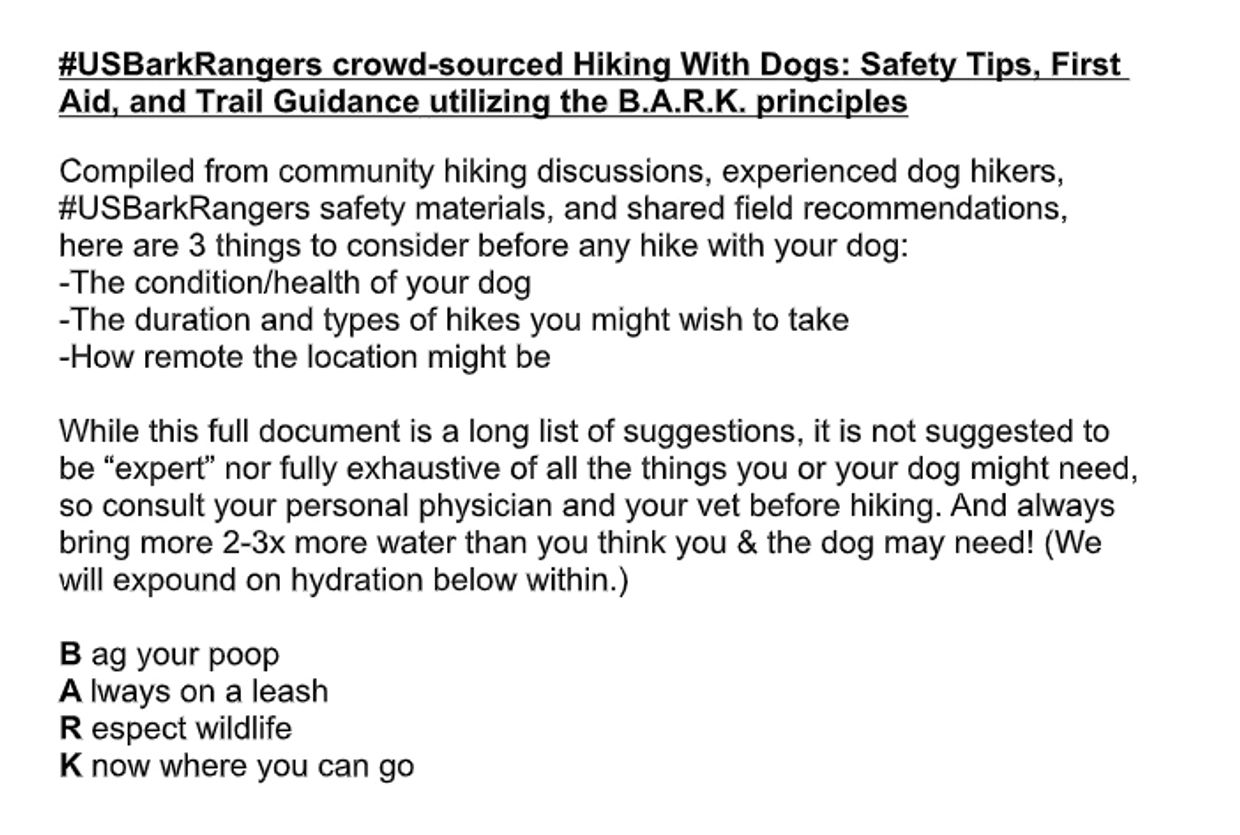
Leave No Trace Practices/B.A.R.K. Principles
- Pack out all waste.
- Keep dogs under control.
- Respect wildlife.
- Yield appropriately on trails.
- Do not go off trail!
- Prevent barking disturbances.
- Stay on designated trails.
- Avoid the use of headphones/earbuds to stay situationally aware at all times.
- HAVE FUN! 😀
- Take pics and always hashtag #USBarkRangers when you share!
This website uses cookies.
We use cookies to analyze website traffic and optimize your website experience. By accepting our use of cookies, your data will be aggregated with all other user data.